1031 Exchange & DST Strategy
You have 45 days.
Most investors make their biggest mistake inside that window.
Once your property closes, the clock starts. Investors who plan their reinvestment strategy before closing make better decisions — and keep more of what they've built.

VA, AL & FL
The pattern we see again and again
Four mistakes investors make
after a property sale
Waiting too long to start planning
Most sellers focus on closing the deal — and only start thinking about their 1031 options once the money is in escrow. By then, the 45-day identification window is already compressing your choices. The best DST and replacement property options go quickly. Waiting means settling.
Rushing into a deal just to beat the deadline
Pressure creates bad decisions. Investors who haven't thought through their strategy in advance end up identifying properties they haven't fully evaluated — just to meet the 45-day rule. This is how people end up overpaying, taking on bad debt coverage, or choosing active management when they wanted passive income.
Fixating on tax avoidance instead of wealth strategy
Avoiding taxes is a tactic. Building wealth is the goal. Investors who optimize only for the exchange often end up in a replacement property that doesn't serve their long-term income needs, liquidity position, or estate plan. The 1031 is a tool — it should be used in service of a larger plan.
Not aligning the reinvestment with their next chapter
A physician approaching retirement has different needs than a 42-year-old portfolio builder. Both might be doing a 1031 exchange into a DST — but the structure, timeline, and asset selection should look completely different. Without a strategic framework, investors treat all deals the same.
The insight most advisors won't tell you
The real risk isn't taxes.
It's making the wrong reinvestment decision
under the pressure of a deadline.
Investors who build their strategy before closing don't just save taxes — they sleep better, move faster, and end up in assets that actually serve their life.
Understanding the exchange window
The 1031 clock doesn't wait
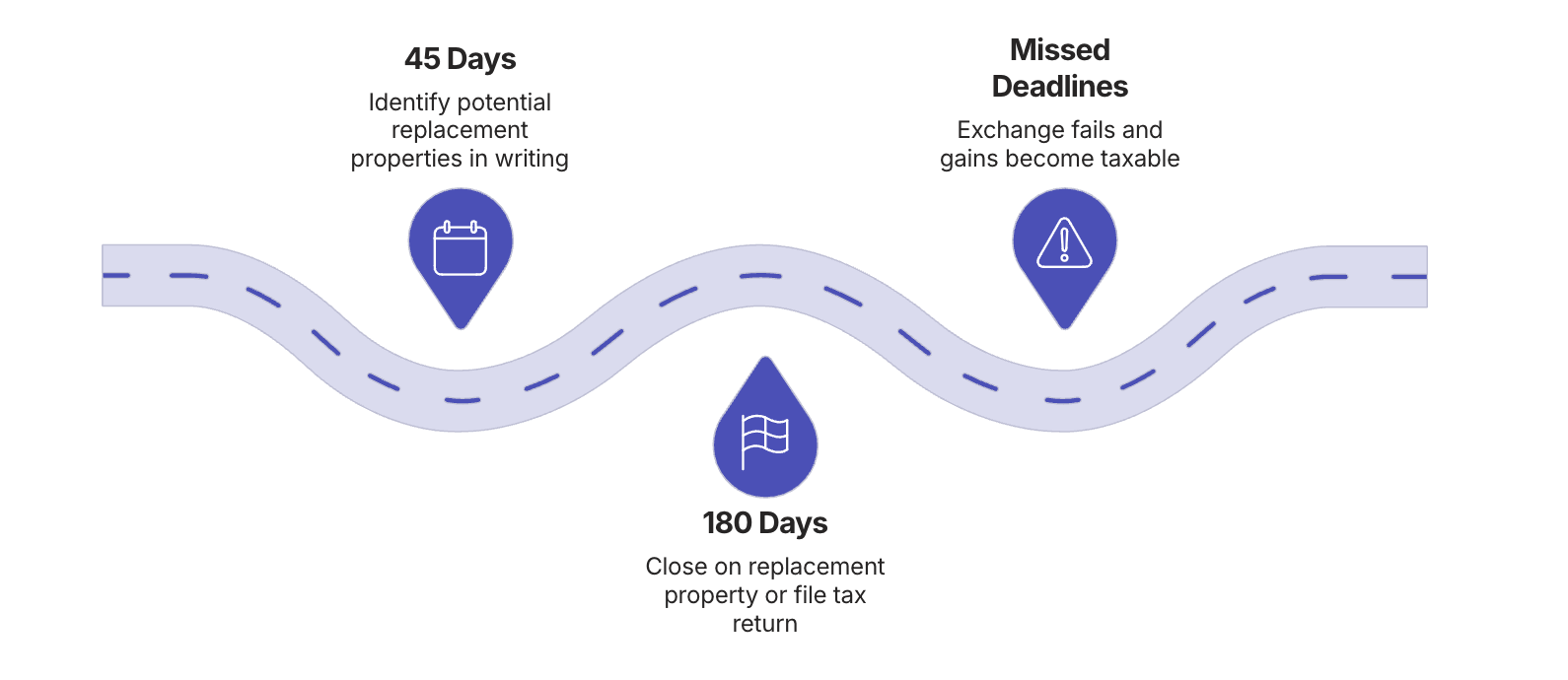
Once your property closes, federal rules impose hard deadlines. Miss them and the tax deferral disappears entirely — there are no extensions for indecision.
Book your strategy call0
Property closes
The exchange clock starts at closing. The funds go to your Qualified Intermediary — not to you.
45
Identification deadline
You must identify up to three replacement properties in writing. No extensions. This is where underprepared investors panic.
180
Closing deadline
You must close on your identified replacement property. Fail to close and the entire gain becomes taxable.
Day 0
When to build your strategy
Investors who plan before closing identify better options, negotiate from a position of clarity, and don't settle under pressure.
The passive alternative
What is a Delaware Statutory Trust?
A Delaware Statutory Trust (DST) allows you to complete a 1031 exchange into a fractional interest in institutional-grade real estate — without taking on property management responsibilities.
Instead of buying and managing a replacement property yourself, you invest alongside other accredited investors in assets like multifamily communities, medical office buildings, net-lease retail, or industrial properties — all operated by a professional sponsor.
You receive passive income, maintain your tax-deferred status, and no longer get calls about broken water heaters.
This strategy is built for you if
- You've recently sold or are under contract on investment property
- You need to complete a 1031 exchange to defer taxes
- You want passive income without managing property
- You have $100K or more in exchange proceeds
- You're planning for retirement income or estate transition
A DST is likely not the right fit if
- You want full operational control of your real estate
- You're looking for a primary residence
- You're working with smaller investment amounts
What planning ahead actually looks like
A retired federal employee reached out three months before she expected to close on a 12-unit property she'd owned for over a decade. She knew she wanted out of active management — but wasn't sure whether a DST, a TIC structure, or another approach made more sense for her situation.
"I came in thinking I needed to figure out the tax piece. What I actually needed was a strategy. By the time my property closed, I already knew exactly which options I'd identify — and why. I didn't feel rushed once."
We worked through her income needs, her estate planning goals, and her timeline. She completed her exchange into a DST within 60 days of closing — below the 180-day limit — with no last-minute scrambling.
Why investors trust Johnny with their capital decisions
Not a seminar presenter.
An operator who advises.
Johnny has navigated his own 1031 exchanges, built a 100+ unit portfolio across three states, and now helps investors think through the same decisions — with a fiduciary obligation to their goals, not a commission.
Before you book
What your 30-minute strategy session looks like
This isn't a sales call. It's a working conversation — structured around your specific situation, timeline, and goals.
We map your timeline and exchange status
Where are you in the sale process? How much runway do you have before the 45-day window opens? What's your current equity position?
We explore active vs. passive options
Not everyone should go into a DST. We'll look at your income needs, management appetite, estate planning goals, and what actually makes sense for your next chapter.
You leave with a written strategy outline
You'll walk away with clarity on which path fits your situation — not a pitch deck. If a DST makes sense, we'll discuss what to look for and why. If it doesn't, we'll tell you that too.
Our commitment to you
No pressure. No pitch. No obligation to work with us after the call.
Johnny operates under a fiduciary standard — meaning he's legally and ethically required to put your interests first. If a DST isn't right for your situation, he'll tell you that directly.
His goal is to help you make a clear, confident decision with your capital — whether that involves him or not.
This session is built for investors who are:
- Currently under contract or recently closed
- Evaluating a 1031 exchange
- Considering the move from active to passive ownership
- Working with $100K+ in exchange proceeds
Ready to build your plan?
Don't let a major capital decision
become a rushed one.
If you're navigating a property sale, 1031 exchange, or evaluating a DST — this conversation is designed to help you slow down, think clearly, and move forward with confidence.
Strategy call: 30 minutes · Complimentary · No sales pitch
Johnny Lynum The Military CEO

1031 Exchange & DST Strategy
You have 45 days.
Most investors make their biggest capital mistake inside that window.
Once your property closes, the clock starts. Investors who plan their reinvestment strategy before closing make better decisions — and keep more of what they've built.
30-minute session 🔹 Complimentary 🔹 No commitment required
THE PATTERN WE SEE AGAIN… AND AGAIN.
Four mistakes investors make
after a property sale
-
Most sellers focus on closing the deal — and only start thinking about their 1031 options once the money is in escrow. By then, the 45-day identification window is already compressing your choices. The best DST and replacement property options go quickly. Waiting means settling.
-
Pressure creates bad decisions. Investors who haven't thought through their strategy in advance end up identifying properties they haven't fully evaluated — just to meet the 45-day rule. This is how people end up overpaying, taking on bad debt coverage, or choosing active management when they wanted passive income.
-
Avoiding taxes is a tactic. Building wealth is the goal. Investors who optimize only for the exchange often end up in a replacement property that doesn't serve their long-term income needs, liquidity position, or estate plan. The 1031 is a tool — it should be used in service of a larger plan.
-
A physician approaching retirement has different needs than a 42-year-old portfolio builder. Both might be doing a 1031 exchange into a DST — but the structure, timeline, and asset selection should look completely different. Without a strategic framework, investors treat all deals the same.
THE INSIGHT MOST INVESTORS WON’T TELL YOU
The real risk isn't taxes.
It's making the wrong reinvestment decision under the pressure of a deadline.
Investors who build their strategy before closing don't just save taxes — they sleep better, move faster, and end up in assets that actually serve their life.
Understanding the exchange window
The 1031 clock doesn't wait
Once your property closes, federal rules impose hard deadlines. Miss them and the tax deferral disappears entirely — there are no extensions for indecision.
-
The exchange clock starts at closing. The funds go to your Qualified Intermediary — not to you.
-
You must identify up to three replacement properties in writing. No extensions. This is where underprepared investors panic.
-
You must close on your identified replacement property. Fail to close and the entire gain becomes taxable.
-
When to build your strategy
Investors who plan before closing identify better options, negotiate from a of clarity, and don't settle under pressure.
If This Is You…
You have a property under contract or recently sold
You’re considering a 1031 exchange
You’re unsure whether to go active or passive
You want to preserve your equity and reduce taxes
You don’t want to make a rushed decision under pressure
This guide was built for you.
The Real Risk Isn’t Taxes — It’s Timing
Most investors focus on avoiding taxes.
But the real risk is making the wrong reinvestment decision under pressure.
30 minutes • Complimentary • Limited availabilityThe passive alternative
What is a Delaware Statutory Trust?
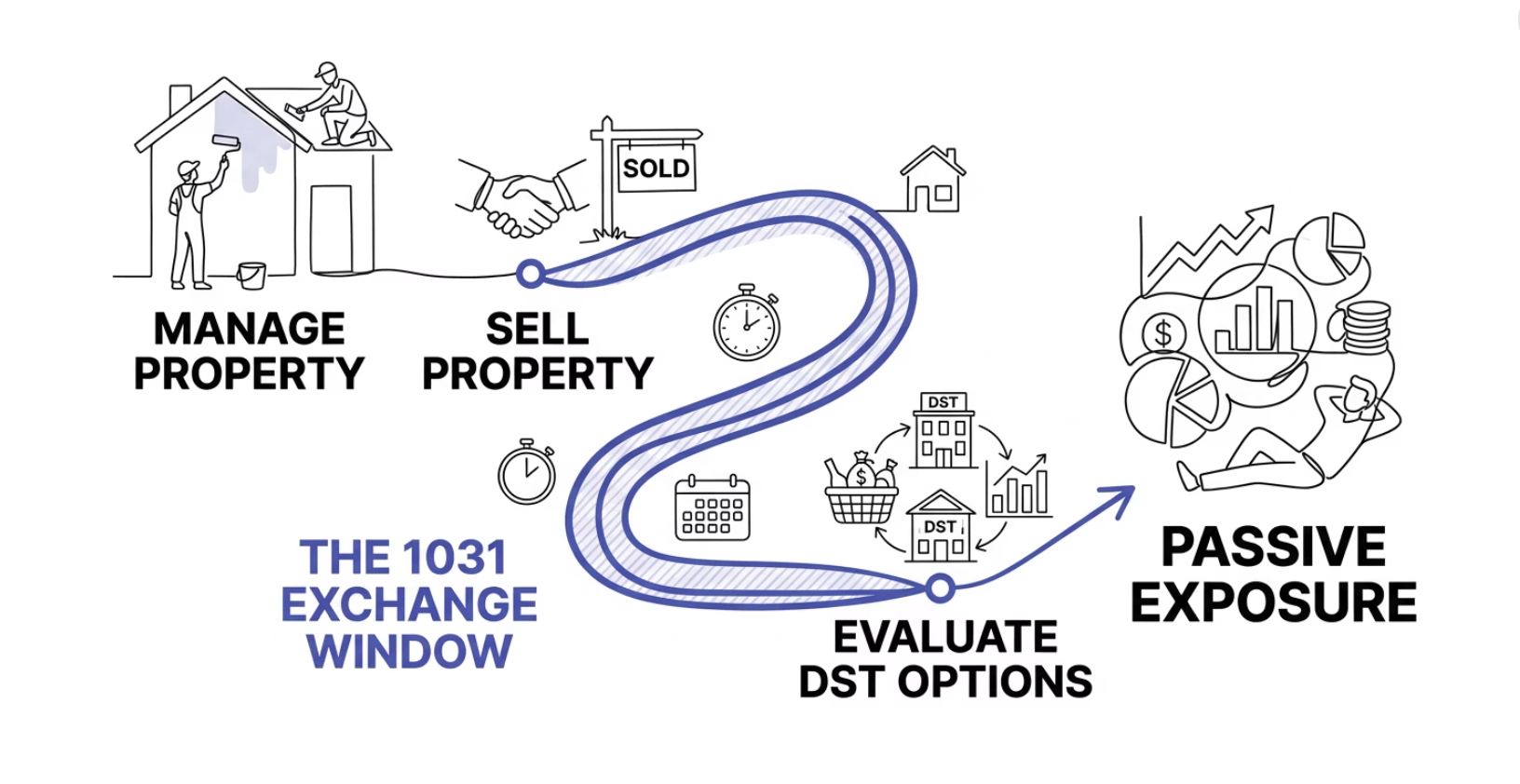
A Delaware Statutory Trust (DST) allows you to complete a 1031 exchange into a fractional interest in institutional-grade real estate — without taking on property management responsibilities.
Instead of buying and managing a replacement property yourself, you invest alongside other accredited investors in assets like multifamily communities, medical office buildings, net-lease retail, or industrial properties — all operated by a professional sponsor.
You receive passive income, maintain your tax-deferred status, and no longer get calls about broken water heaters.
A Delaware Statutory Trust allows you to complete a 1031 exchange into institutional real estate without managing property.
This strategy is built for you if
You've recently sold or are under contract on investment property
You need to complete a 1031 exchange to defer taxes
You want passive income without managing property
You have $100K or more in exchange proceeds
You're planning for retirement income or estate transition
A DST is likely not the right fit if
You want full operational control of your real estate
You're looking for a primary residence
You're working with smaller investment amounts
Why Investors Trust Johnny Lynum With Their Capital Strategy
Johnny Lynum is not a seminar presenter. He's an operator and a registered advisor who has navigated real capital decisions, including 1031 exchanges, passive real estate transitions, and large-scale portfolio strategy, for himself and his clients.
🎖️ 20 Years of Military Leadership | U.S. Air Force Lt. Colonel (Ret.) The same discipline that led people and managed high-stakes operations in uniform now drives every client engagement. When timelines matter, like a 45-day identification window, precision isn't optional.
📋 Registered Investment Advisor Representative | Series 22/65 Licensed Advisory services offered through Innovation Partners LLC, an SEC-registered investment adviser (Member FINRA/SIPC). Johnny operates under a fiduciary framework, meaning his recommendations are structured around your goals, not a commission.
🏢 100+ Units Owned | Active Real Estate Operator Since 2006 Johnny doesn't just advise on real estate, he owns it. From multifamily assets in Virginia, Alabama, and Florida to a 96-unit apartment community in Montgomery, AL, he understands what it means to evaluate, acquire, and transition real property at scale.
📚 Author | The Financial Security Blueprint & Millionaire Real Estate Success Strategies Two published books on wealth strategy, passive income, and financial independence, written for investors who want frameworks, not fluff.
🎤 200+ Workshops & Masterclasses Delivered Featured on multiple real estate and wealth-building platforms, and a sought-after speaker on DSTs, 1031 exchanges, and alternative investments for high-net-worth investors.
👥 13,000+ Member Investor Community Founder of REI Genius, a national investor education platform with members across the country, active and retired military, federal professionals, and high-net-worth real estate operators.

Who a DST is for—and when it makes sense
From Active Ownership to Passive Income
Don’t Let a Major Capital Decision Become a Rushed One
Get Clear Before You Commit Capital
If you are navigating a property sale, 1031 exchange, or evaluating a DST strategy, this conversation is designed to help you slow down, think clearly, and move forward with confidence.
30 minutes • Complimentary • Limited availabilityThe Biggest Mistake Investors Make After a Sale
Waiting too long
Rushing into a deal
Focusing only on taxes
Not aligning with long-term goals
30 minutes • Complimentary • Limited availabilityThis content is for informational and educational purposes only and should not be construed as investment, tax, or legal advice. Investment strategies discussed may not be suitable for all investors. Advisory services are offered through a registered investment adviser. Eligibility for certain investments, including Delaware Statutory Trusts, may be limited to accredited investors as defined by applicable regulations.