DST vs. Direct Property in a 1031 Exchange: Which Replacement Strategy Actually Fits Your Life?
I get asked some version of this question almost every week: "Johnny, should I just buy another rental, or should I look at a DST?" It's a fair question, and it's the wrong question to answer with a generic recommendation. I've seen both paths work extremely well for the right investor, and I've seen both paths cause real regret when someone chose based on habit instead of honest self-assessment.
In the military, we didn't pick a strategy because it was familiar. We picked it because it matched the mission and the terrain. Choosing between a DST and direct property replacement deserves that same discipline. Let's walk through it properly.
The Baseline: Both Options Can Satisfy Your 1031 Exchange
Before comparing them, it's worth restating what they have in common. Both a directly owned replacement property and a DST interest can qualify as like-kind property under Section 1031, meaning both can allow you to defer capital gains tax and depreciation recapture on your sale, as long as the other exchange requirements we've covered in this series are met: using a Qualified Intermediary, staying inside the 45-day identification and 180-day closing windows, and reinvesting proceeds appropriately.
From a pure tax mechanics standpoint, the IRS treats them the same way. The difference isn't in whether the exchange works. It's in what your life looks like after it closes.
Direct Property Ownership: What You're Actually Signing Up For
When you exchange into a directly owned replacement property, you're stepping back into the role you likely already know: landlord, asset manager, decision maker.
Advantages of direct ownership:
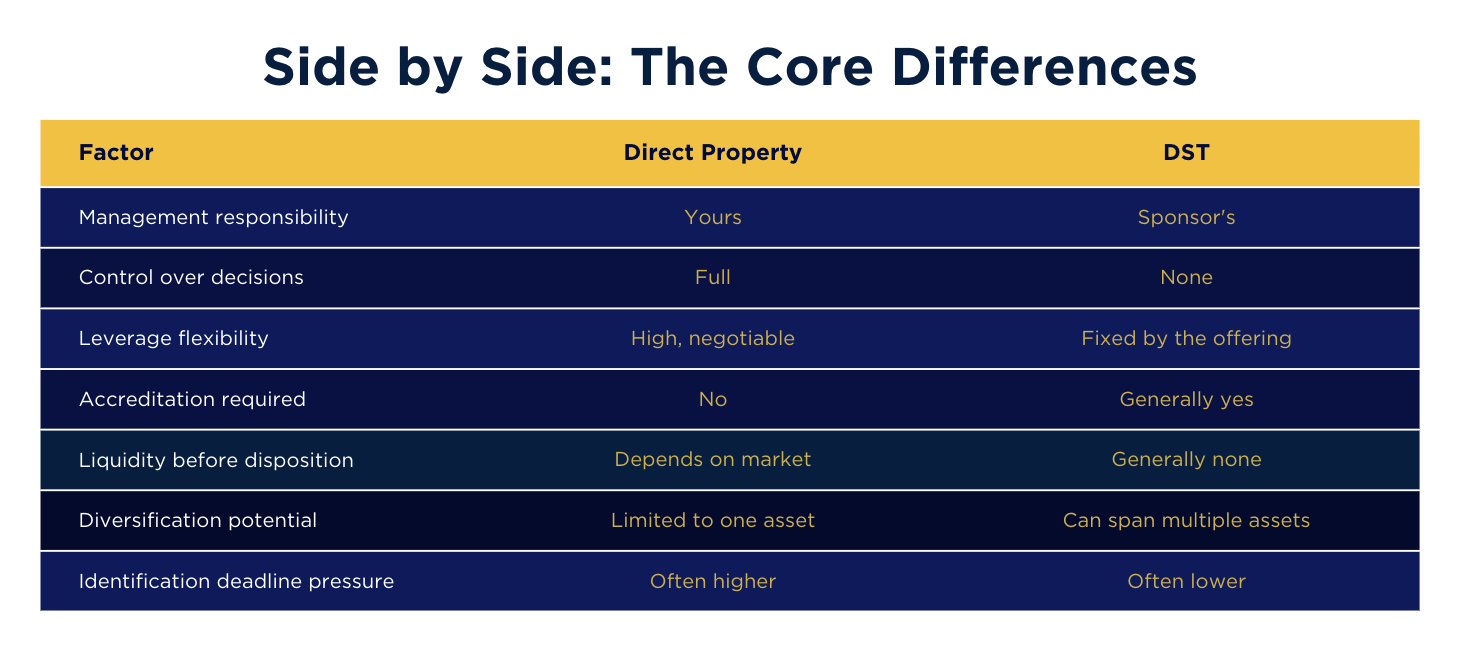
Full control. You decide when to sell, how to manage the property, what improvements to make, and who to lease it to.
Leverage flexibility. You can finance the property using terms you negotiate, potentially amplifying returns (and risk) beyond an all-cash structure.
No accreditation requirement. Direct property ownership doesn't require you to qualify as an accredited investor the way most DST offerings do.
Direct depreciation benefits. You continue to claim depreciation as the sole or primary owner, with full visibility into how it's calculated.
Tradeoffs of direct ownership:
Active management responsibility. Tenant issues, maintenance, vacancy risk, and property management all remain your responsibility, whether you handle them yourself or hire it out.
Concentration risk. A single replacement property means your equity is concentrated in one asset, one market, and often one tenant or tenant pool.
Identification pressure. Finding, underwriting, and closing on a suitable replacement property inside your 45-day window can be genuinely stressful, especially in competitive markets.
Illiquidity of a different kind. Selling a directly owned property later involves its own timeline, marketing process, and transaction costs.
DST Ownership: What You're Actually Signing Up For
A DST interest, as we covered in an earlier article in this series, gives you fractional, passive ownership in institutional-grade real estate, professionally managed by the trust sponsor.
Advantages of a DST:
True passivity. No tenant calls, no maintenance decisions, no property management oversight. The sponsor runs the asset.
Access to institutional-grade real estate. Multifamily portfolios, industrial distribution centers, and net lease retail assets that would be difficult or impossible for an individual investor to purchase directly.
Diversification potential. Some investors split their exchange proceeds across multiple DST offerings and asset classes rather than concentrating everything in one property.
A reliable solution for identification deadline pressure. DST offerings are often ready to close relatively quickly, which can reduce the stress of the 45-day identification window.
Tradeoffs of a DST:
No operational control. You're a passive investor. The sponsor makes management and disposition decisions, not you.
Illiquidity. There's generally no public market to sell your DST interest before the trust's planned disposition. These are intended as longer-term holds.
Accredited investor requirement. Most DST offerings are limited to investors who meet specific income or net worth thresholds under SEC rules.
Sponsor-dependent outcomes. Your results are tied to the quality and track record of the sponsor managing the underlying real estate, which makes due diligence on the sponsor just as important as due diligence on the property.
Fees and offering costs. DST structures typically involve upfront and ongoing fees that need to be understood clearly before investing.
The Real Question: What Season of Life Are You In?
This is where the decision actually gets made, and it has less to do with tax mechanics and more to do with honest self-assessment. A few questions I walk clients through:
Do you still want to be actively involved in real estate decisions, or are you ready to hand off operational control? There's no wrong answer here, but there is a wrong answer if you pick the option that doesn't match your honest preference.
How much time and energy do you realistically want to spend on property management going forward? Be honest about this one. I've watched investors underestimate how much they were ready to be done with active management.
Do you meet the accredited investor requirements, and are you comfortable with an illiquid, longer-term hold? If liquidity in the next few years matters to you, that's a real constraint worth naming upfront.
Is your goal concentration in a single asset you understand deeply, or diversification across multiple properties and asset classes?
Are you running up against your identification deadline without a strong direct purchase option lined up? Sometimes the honest answer is that a DST solves a timing problem as much as a lifestyle preference.
Some investors don't choose one or the other. A combined approach, part of the exchange proceeds into a directly owned property and part into a DST, can offer a middle path: continued involvement in one asset while gaining diversification and passive income through the other.
A Word of Caution on Either Path
Neither option is inherently superior. I've seen investors thrive with direct ownership well into their seventies because they genuinely enjoyed the work and had the systems in place to manage it efficiently. I've also seen investors hang onto direct ownership out of habit long after it stopped serving their actual goals, simply because switching felt unfamiliar.
The mistake isn't choosing direct property or choosing a DST. The mistake is choosing either one without honestly evaluating what fits your current season of life, your risk tolerance, and your long-term plan.
Important Disclosures
This article is for educational purposes only and does not constitute tax, legal, or investment advice. Both direct property ownership and DST investments carry distinct risks and are not interchangeable in terms of liquidity, control, and suitability. DST investments are generally illiquid, involve potential loss of principal, and are typically limited to accredited investors. Direct real estate ownership carries its own risks, including market, tenant, and management risk. Past performance is not indicative of future results, and no strategy or structure guarantees income, appreciation, or a specific tax outcome. Please consult a qualified financial advisor, CPA, and attorney to determine which replacement strategy fits your specific circumstances.
Ready to Decide Which Path Actually Fits You?
If you're weighing direct property ownership against a DST for your next exchange and want an honest, personalized look at which one fits your goals, let's talk.
Book a complimentary strategy conversation: https://www.johnnylynum.com/alignment.