How Top Investors Decide Between DSTs and Direct Real Estate
You want real estate wealth, but do you want the headaches? Leaky faucets, late-night calls from tenants, and constant maintenance are part of direct ownership. But what if you could earn the same income and appreciation without lifting a finger?
Enter Delaware Statutory Trusts. For elite investors, the choice between DSTs and direct ownership is not just about convenience. It is a strategic decision that affects taxes, cash flow, scalability, and long-term wealth. Here is the breakdown.
What is Direct Real Estate Ownership?
Direct ownership means you purchase and hold property outright. You control every decision from leasing to renovations, but you also carry all responsibility, including:
Tenant management
Maintenance and repairs
Property taxes and insurance
Financing and debt management
Direct ownership can generate high returns, but it requires time, effort, and risk tolerance.
What is a Delaware Statutory Trust?
DSTs are passive investment vehicles that allow multiple investors to own a fraction of large-scale, professional-grade properties.
Fractional ownership in institutional-quality real estate
Professionally managed, hands-off approach
Eligible for 1031 exchanges for tax deferral
Predictable cash flow without landlord responsibilities
DSTs allow investors to scale quickly without the operational burdens of direct ownership.
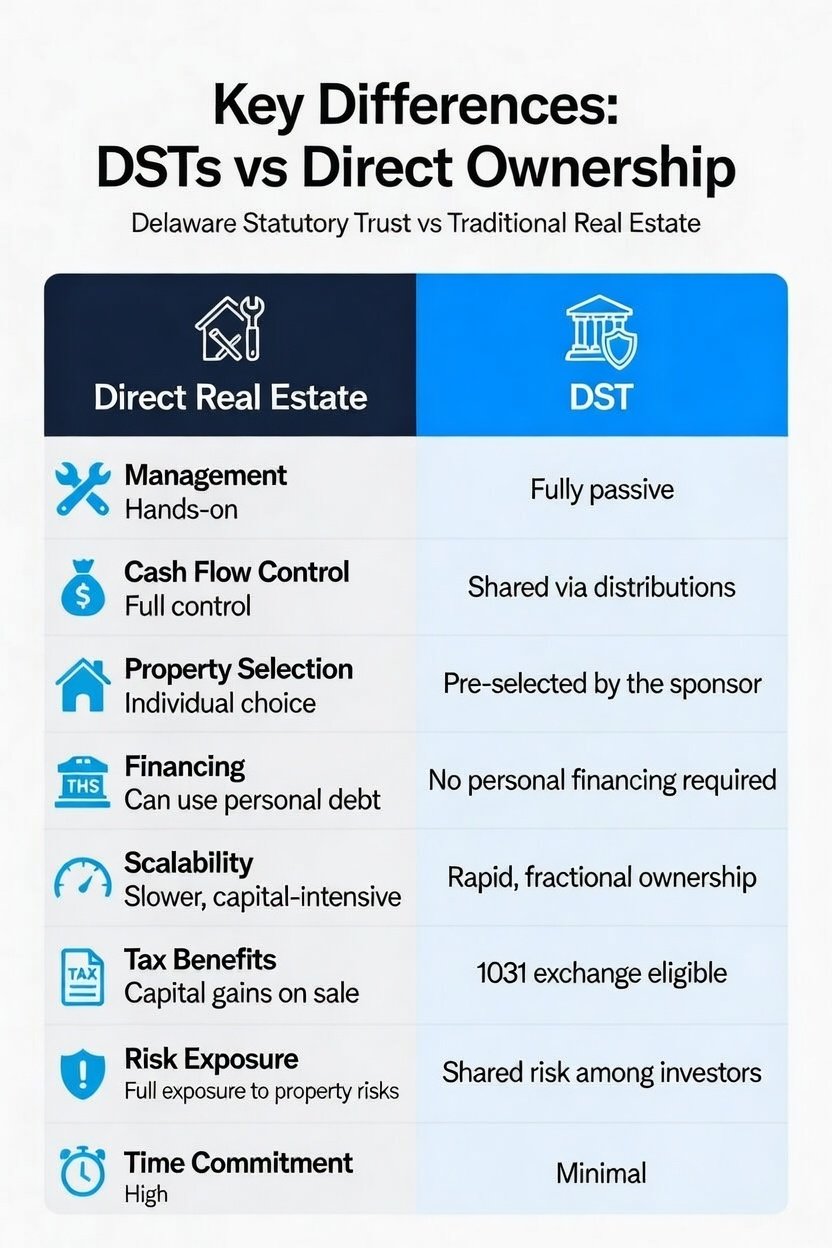
Why HNW & Elite Investors Use DSTs
Hands off scaling: They can access large multifamily, office, or commercial properties that they could not buy individually.
Tax efficiency: DSTs qualify for 1031 exchanges, deferring capital gains taxes.
Portfolio diversification: Multiple DSTs in different markets or asset types help reduce risk.
Passive income: Investors receive steady cash flow without managing tenants or repairs.
When Direct Ownership Makes Sense
Direct ownership has its advantages:
Full control over operations, improvements, and strategy
Potential for higher returns if the property is managed expertly
Ability to leverage personal financing and equity-building strategies
For investors who enjoy hands-on management, value operational control, or want local property exposure, direct ownership may be preferable.
10 Doors + Second Job or 100 Doors + Freedom
Two investors. Same capital. Different outcomes.
Investor A buys a 10-unit building. He manages tenants, handles repairs, and oversees everything. Returns are strong. Equity grows. But growth depends on his time and attention. More units mean more responsibility.
Investor B invests through a Delaware Statutory Trust owning 100 units. Professional operators manage the property. She receives passive income. She uses a 1031 exchange to defer taxes and scale. Minimal effort. Predictable cash flow. Easier expansion.
Both strategies build wealth.
One tie returns to your time. The other lets capital compound without you.
The Ownership Debate
DSTs are passive, scalable, tax-efficient, and require a lower time commitment.
Direct ownership offers full control, potentially higher returns, and a more hands-on approach.
Elite investors often use both strategies to optimize cash flow, tax deferral, and portfolio growth.
Choosing the right strategy depends on your goals, risk tolerance, time availability, and long-term wealth plan.
Hands Off or Hands On?
DSTs and direct ownership can both build wealth, but your choice determines how much time, risk, and effort you invest. If you want to scale faster, stay hands off, and maximize tax benefits, DSTs are worth exploring. Let’s assess which strategy aligns best with your portfolio and financial freedom goals. https://calendly.com/johnnylynum/dst