The Complete Guide to 1031 Exchanges for Sophisticated Investors
The 1031 Exchange Secret That Lets Elite Investors Grow Wealth and Defer Taxes
Imagine selling a property and walking away without paying capital gains taxes—then using the full proceeds to buy an even bigger, higher-income property. Sounds like a fantasy? Not for savvy investors using 1031 exchanges.
Most investors leave hundreds of thousands of dollars on the table because they don’t understand how to leverage this powerful IRS strategy. For high-net-worth and sophisticated investors, 1031 exchanges are a cornerstone for portfolio growth, tax deferral, and scaling wealth efficiently. Here’s everything you need to know.
What is a 1031 Exchange?
A 1031 exchange, named after Section 1031 of the Internal Revenue Code, allows investors to defer paying capital gains taxes when selling an investment property—if the proceeds are reinvested into a “like-kind” property.
Key points:
You must reinvest the full proceeds from the sale into the new property.
The new property must be of equal or greater value.
Strict timelines apply: identify the replacement property within 45 days and close within 180 days.
Both the sold and purchased properties must be held for investment or business purposes—not personal use.
Essentially, a 1031 exchange allows you to swap one property for another, compound wealth, and legally defer taxes—turning capital gains into growth capital instead of an immediate tax bill.
Why 1031 Exchanges Matter for Elite Investors
Tax Deferral:
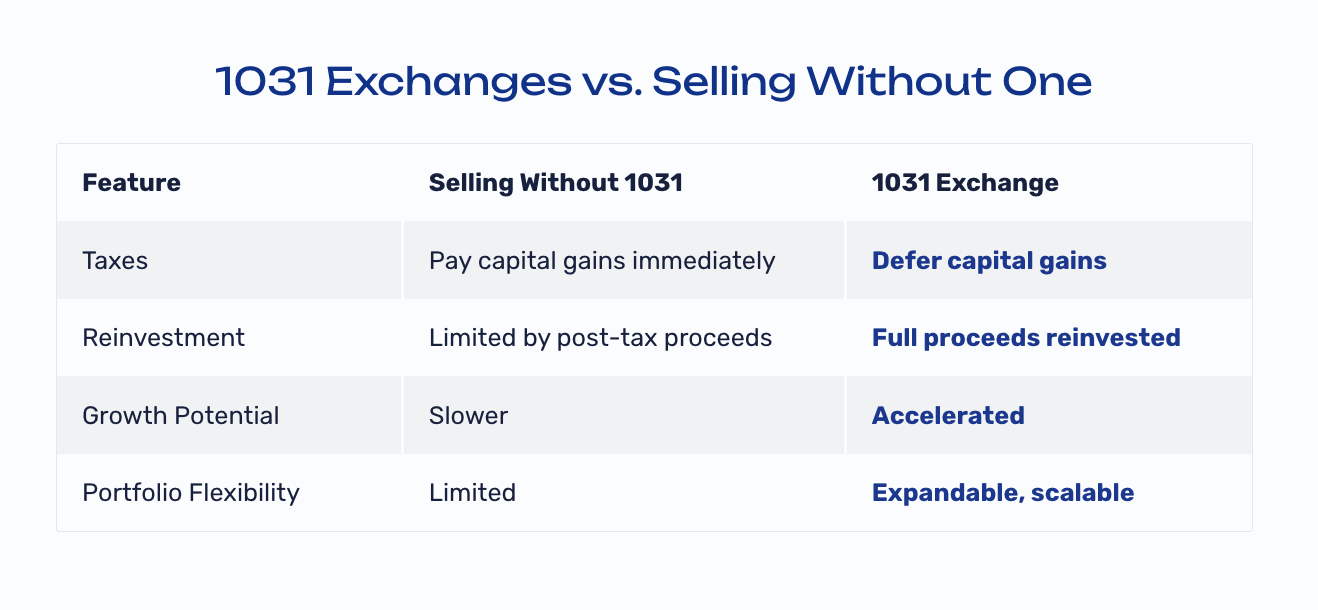
By deferring capital gains taxes, you can reinvest 100% of your proceeds, which accelerates portfolio growth over time.Portfolio Scaling:
Investors can move from smaller properties to larger multifamily, commercial, or institutional-grade assets, all while remaining tax-efficient.Wealth Preservation:
Taxes can erode your returns over time. 1031 exchanges help protect and compound wealth across generations.Strategic Flexibility:
You can diversify into different property types, markets, or investment structures—including DSTs, which also qualify for 1031 exchanges.
Real-World Example
Imagine an investor sells a single-family rental for $500,000 with $150,000 in capital gains. Without a 1031 exchange, they’d pay roughly $37,500 in federal capital gains tax (assuming 25%).
Instead, they use a 1031 exchange to reinvest into a 50-unit multifamily building, generating higher cash flow and appreciation potential.
Result: Taxes are deferred, the portfolio scales, and passive income increases—all without losing money to taxes.
This is how elite investors leverage 1031 exchanges to turn one property into a multi-property portfolio over time.
How to Approach 1031 Exchanges
Work With a Qualified Intermediary (QI):
The IRS requires a QI to handle the exchange, ensuring compliance with strict rules.Understand Timelines:
You have 45 days to identify replacement property(ies) and 180 days to close. Missing deadlines invalidates the exchange.Match Like-Kind Properties:
Most real estate investments qualify, including single-family, multifamily, commercial, and certain DSTs.Align With Goals:
Use 1031 exchanges as part of a strategic growth plan, not just a tax workaround.
Key Takeaways
1031 exchanges allow deferred taxes and portfolio scaling.
They provide access to larger, institutional-quality assets while keeping capital at work.
Combining 1031 exchanges with strategies like DSTs or multifamily investing multiplies growth potential.
Compliance and planning are critical—timelines and rules must be followed.
A 1031 exchange isn’t just a tax tool—it’s a strategic lever for wealth-building.
For investors serious about portfolio growth, passive income, and long-term legacy, understanding and using 1031 exchanges is non-negotiable. Let’s explore how to leverage a 1031 exchange for your next investment move. https://calendly.com/johnnylynum/dst