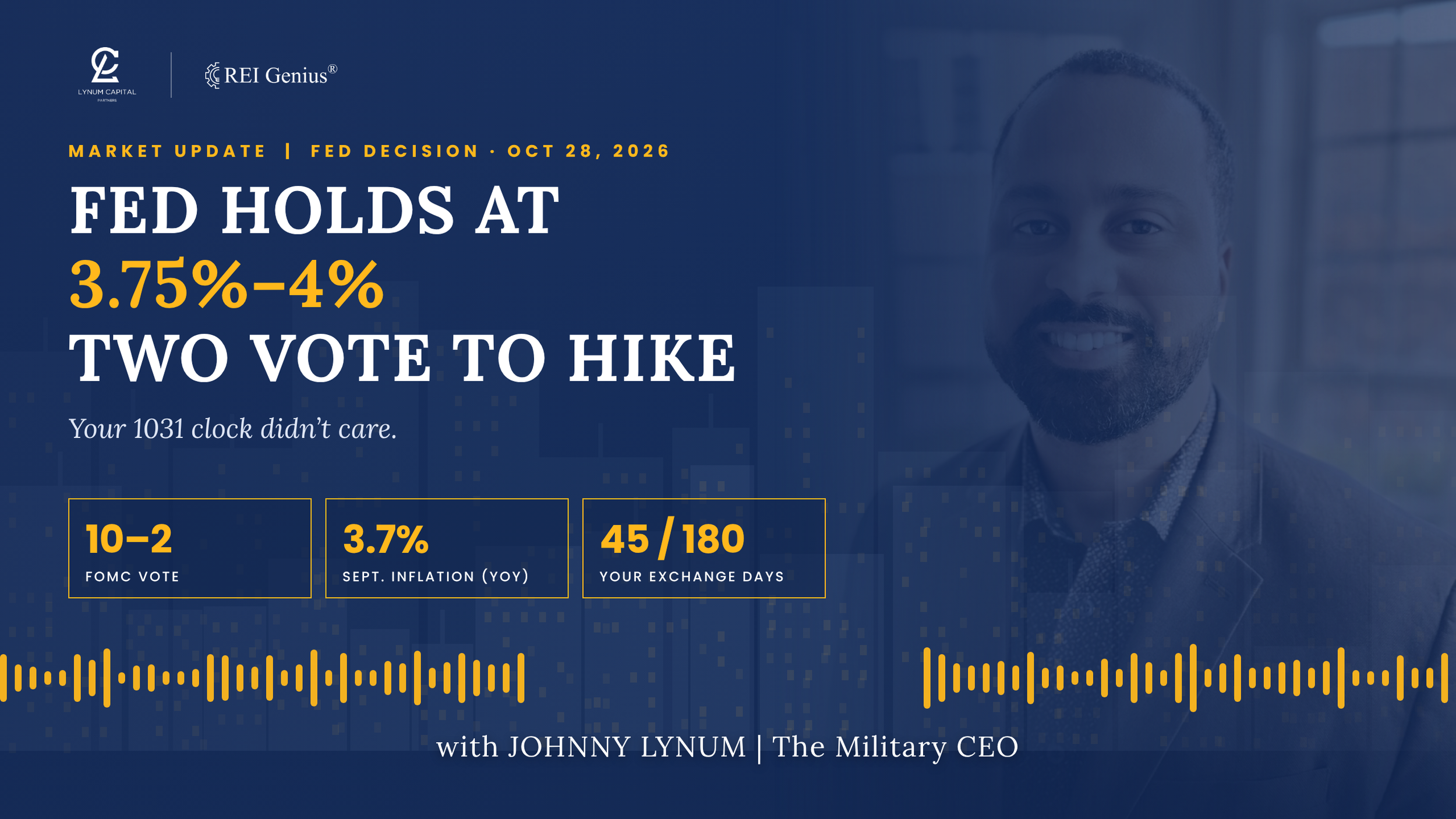
The Fed raised rates in September for the first time since 2023, and on October 28 it held steady while two members wanted to go higher.
We've all spent years waiting on the Fed to give us a cleaner runway. In 2026 it's gone the other way. The Fed raised rates in September for the first time since 2023, and on October 28 it held steady while two members wanted to go higher.
If you've got a sale closing this fall, or a 1031 deadline already running, "wait and see" is a comfortable phrase that doesn't match how the calendar works. Let's walk through what the Fed actually did and how we'd think about it.
What the Fed actually did
The FOMC left the target range at 3.75% to 4%. The vote was 10-2. Governor Lisa Cook, in her first dissent, and Cleveland Fed President Beth Hammack both wanted a quarter-point increase.
The reason is inflation. September consumer prices rose 3.7% year over year, up from 3.4% in August, against a 2% target. In the September projections, 16 of 18 officials supported one more hike this year, so a December move is the base case many in the market are planning around. Chair Warsh also said the Fed will hold fewer rate-setting meetings starting in 2027. The 10-year Treasury closed at 4.992% on October 27 after briefly crossing 5% earlier this fall.
What deal makers are saying
The commentary from the commercial real estate side was split, which is what we'd expect at a turning point.
Ian Ross of SomeraRoad said that this late in the year, with this much uncertainty, "most people just put their pencils down." He also noted that many fall deals involve distressed sellers, which gives bargain hunters an opening. Berkadia's Patrick McGlohn said rising Treasury yields made pipeline deals harder to pencil and pushed lenders toward a "valuation reset." Jay Neveloff of HSF Kramer said he hasn't seen a slowdown, with private lenders still active.
Economist Aaron Terrazas put the split plainly: industrial is strong, while multifamily faces oversupply in the Sun Belt. Delinquencies have risen, he said, but he doesn't see broad spillover.
Where the stress shows up
KBRA's October CMBS report puts the 30-plus day delinquency rate at 7.7%, or $25.7 billion. The broader distress rate, which includes loans that are current but in special servicing, is 10.3%. For conduit loans it's 12.5%. KBRA says multifamily and industrial delinquencies declined in the month, while office and mixed-use distress rose. The new delinquencies were mostly large office and mixed-use properties.
Note the difference between that and a headline about "commercial real estate is in trouble." It depends on property type, loan type, and when the debt comes due.
A picture you can relate to
Here's a hypothetical, not a real client. An investor closes on the sale of a rental property in mid-November. The 45-day identification window runs into early January, and the 180-day exchange period may be shorter than six months if the tax return deadline comes first and no extension is filed. That's a rule worth confirming with a tax advisor and a qualified intermediary before closing, not after.
Now add the rate backdrop. The investor was hoping to buy with a 65% loan, but the lender now offers less leverage at a higher rate. Holiday week brokers are slower to respond, and a quarter of the pipeline has "put their pencils down." The question stops being "where will the Fed be in March?" and becomes "what can I actually close inside my window, and what happens to this deal if rates are higher at refinance?"
What this means for the Sun Belt
Sun Belt migration and job growth are still real. But Terrazas's point about oversupply matters. A strong population story doesn't override a supply wave that's still leasing up. When we look at Sun Belt multifamily, we'd want to see how much new inventory is coming, what concessions are in use, and when the debt matures. Industrial and necessity-based net lease have different risks, such as tenant credit, lease length and rent resets, but they aren't carrying the same new-supply issue.
Investor Takeaway
First, the exchange clock is fixed and the Fed isn't. Build your timeline backward from your 45-day and 180-day dates, and confirm the year-end rule with your tax advisor.
Second, run every deal at a higher rate. Ask what happens at refinance if rates are 100 basis points above today, and whether the deal still works with lower proceeds.
Third, separate the property types. National headline numbers hide very different situations across office, multifamily, industrial and retail.
Fourth, if a DST is one of the options you're evaluating, read the sponsor's debt terms, maturity dates, reserves and fees closely. DSTs are generally limited to accredited investors, are illiquid, aren't guaranteed to pay distributions or return principal, and can lose value.
Nobody can tell us what the Fed will do in December. We can build a plan that works across more than one answer.
Disclaimer
This article is for informational and educational purposes only. It does not constitute financial, investment, tax, or legal advice. Past performance is not indicative of future results. Always consult with a qualified financial professional, tax advisor, or attorney before making any investment decisions. Individual results will vary.
If you have a sale coming up or an exchange clock running, let's talk it through privately. No pressure, just a clear look at your timeline and options.
REI Genius: The SDIRA and Multifamily Investment Network | Lynum Capital Partners | Private Wealth Advisory Host, Million Dollar Coffee Chat | Deal Makers Club | 20-Year Air Force Veteran | Licensed Financial Advisor 📞 757-551-2989
Sources: Commercial Observer, Fed holds rates steady (Oct 28, 2026); KBRA, CMBS Loan Performance Trends: October 2026; IPX1031, year-end shorter time periods.