Most investors saw an industrial lot. A Virginia Beach developer saw a $12.5M housing opportunity.
We’re living through one of the most fascinating shifts in American real estate history, and most people are still asleep at the wheel. While the mainstream conversation obsesses over interest rates and stock market swings, a quiet repositioning is happening in markets like Northern Virginia that deserves every investor’s full attention.
Let me break down why a single $12.5 million deal in Manassas Park, Virginia, tells us everything we need to know about where smart capital is moving in 2026.
The Deal That Stopped Me in My Tracks
RST Development, a Virginia Beach-based multifamily firm, just acquired the Conner Commerce Center, a fully-leased, 70,590-square-foot industrial complex sitting on nearly 7 acres just off Route 28, about 30 miles southwest of Washington, D.C.
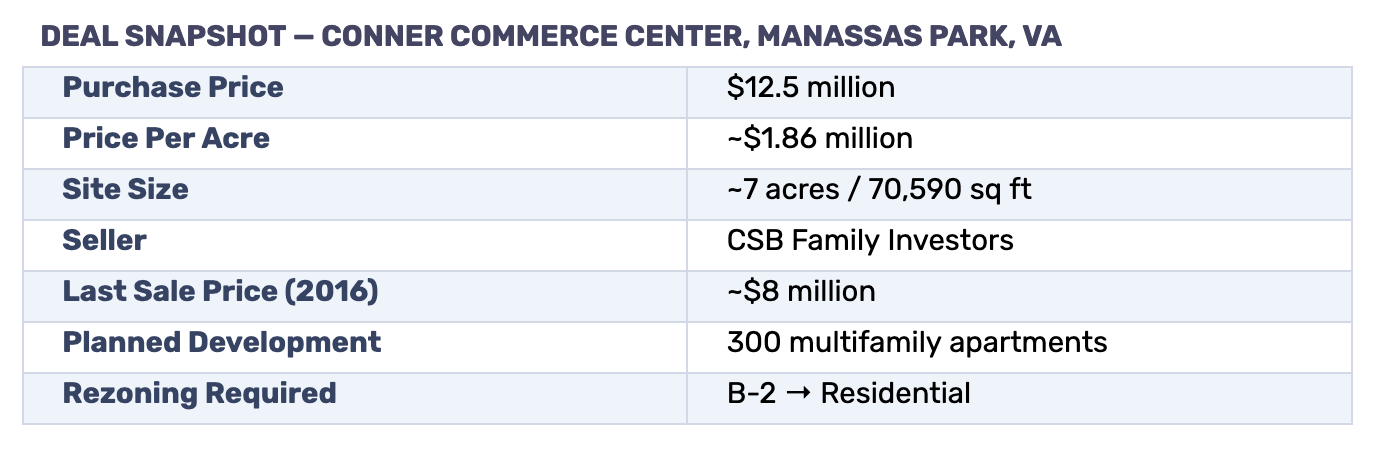
The seller, CSB Family Investors, bought this same property about a decade ago for just over $8 million. They walked away with a healthy gain, and RST walked in with a vision. That’s the game.
Why This Is Bigger Than One Deal
Here’s the part that most people skip right past: this property is located inside Manassas Park’s City Center Redevelopment District. That matters enormously. The district was designed specifically to transform underutilized commercial land into a “vibrant economic hub” with an integrated mix of housing, retail, and office, and it offers tax incentives for qualifying projects.
Across the street from this industrial site sits the Shoppes at City Center, a pedestrian-first development complete with apartments, retail, restaurants, a public library, and city hall. The Manassas Park VRE commuter rail station is also nearby, putting workers on a direct path into the D.C. metro corridor.

This isn’t a developer taking a blind swing. RST isn’t gambling. They are threading a needle between infrastructure, transit access, tax incentives, and a demonstrable housing demand gap, and doing it on land that was previously sitting under a three-story commercial building leased to a wholesale importer, an auto dealer, and an insurance office.
The Residential Supply Crisis Is Doing the Heavy Lifting
The reason deals like this one keep happening is straightforward: we have severely underbuilt housing for over a decade. The National Association of Realtors estimated the U.S. housing shortage at approximately 5.5 million units heading into 2025, with high-demand metro-adjacent suburbs like Northern Virginia among the hardest hit.
Northern Virginia has seen consistent population growth driven by federal employment, defense contracting, and tech sector expansion. Yet residential construction has lagged far behind demand in the Route 28 corridor and surrounding Manassas metro area. That supply-demand imbalance is precisely the environment where industrial-to-residential conversions become not just attractive, but arguably among the more rational repositioning strategies available to well-capitalized operators.
“In my experience, the most interesting opportunities rarely announce themselves. They tend to hide in plain sight; inside zoning maps, transit studies, and aging industrial corridors that most people drive past without a second thought.”
WHY INDUSTRIAL LAND ATTRACTS SOPHISTICATED OPERATORS
Industrial parcels, especially aging ones in transitional neighborhoods, are typically priced below equivalent residential-zoned land. Developers who understand rezoning dynamics can acquire at a discount, navigate the entitlement process, and emerge with a residential asset positioned for the market. RST paid roughly $1.86 million per acre here. Comparable residential-entitled land in the D.C. suburbs regularly trades at a meaningful premium.
Industrial land often trades at a discount to residential-zoned land in the same corridor
Rezoning risk is real, but in established redevelopment districts, the approval environment is more predictable
Existing tenants (fully leased at sale) generate income to offset carrying costs during the entitlement period
Tax incentive zones like Manassas Park’s City Center District can meaningfully improve project-level economics
RST’s Track Record Tells the Story
RST Development operates under Hercules Real Estate Services alongside affiliate Triangle Construction. Their D.C.-area portfolio includes the 195-unit Galaxy apartments in Silver Spring, Maryland, and the 70-unit Main Street Apartments in Rockville, Maryland; delivered, operating multifamily assets in the same regional market. The Conner Commerce Center is the next step in a well-established playbook.
What We Can Learn as Investors
Whether you’re a passive investor, an active operator, or somewhere in between, this deal offers a clear illustration of several principles worth understanding:
Identify where policy and demand intersect: redevelopment districts signal where local governments have already laid the groundwork
Follow transit: proximity to commuter rail in a major metro is one of the most consistent demand drivers in multifamily
Study the supply gap, not just the narrative: the shortfall in Northern Virginia is a measurable, documented condition
Entitlement complexity is often where value is created: most buyers can’t or won’t navigate it
The Broader Trend: Conversions Are Accelerating
This deal isn’t isolated. Across the country, from suburban Philadelphia to Southern California, developers are targeting aging industrial corridors for residential conversion. Workforce housing within commuting distance of major metros is among the most under-supplied categories in American real estate heading into the second half of this decade. In the DC suburbs alone, conversion projects accounted for hundreds of proposed new units in formerly commercial or light-industrial zones in 2025, according to regional planning data.
The Real Value Was Never the Warehouse
A Virginia Beach developer just paid $12.5 million for a fully-leased industrial building, not because they wanted a warehouse, but because they saw 300 apartment units underneath it. They identified transit access, a redevelopment incentive zone, a documented housing shortage, and a motivated seller. That combination doesn’t come together by accident.
The property has been sitting there since 1985. It took the right operator, the right market conditions, and the right moment to unlock what was hiding in plain sight. Deals like this exist in every major metro. The question is whether you’re positioned to recognize, evaluate, and act when the time comes.
Want to explore whether we’re a fit to work together?
Whether you’re just getting started or already active in real estate, I’d genuinely enjoy a private conversation about where you are and where you’re trying to go. →www.johnnylynum.com/alignment
DISCLOSURE
This article is for informational and educational purposes only. It does not constitute investment advice, a solicitation, or an offer to buy or sell any asset. Deal data sourced from CoStar and publicly available records. Market statistics referenced from the National Association of Realtors and regional planning sources. Past performance of any deal or market discussed is not indicative of future results. Always consult with a qualified financial, legal, or real estate professional before making any investment decision.